The AI Selloff Explained: Why Intel Crashed 29% and Big Tech Lost Trillions
By Eoin Villarin, 2026-10-31
Intel fell 28.6% in one day, Amazon is burning cash on AI and the Nasdaq just had its worst month since March 2025. Here is what happened, in plain English, and what it means for you.
Why did tech stocks fall on October 30, 2026?
Tech stocks fell on October 30, 2026, because Intel and Amazon reported results that made investors doubt the payoff from record AI spending. Intel closed down 28.58% after forecasting fourth-quarter sales of $15 billion to $16 billion, below the roughly $17.1 billion analysts expected, as high memory prices hurt PC demand. Amazon's free cash flow turned negative $42.4 billion over 12 months as it poured money into AI data centers. The Nasdaq Composite fell 2.86%, its worst day since June 5.
Key takeaways
- Intel closed at $65.76 on October 30, 2026, down 28.58%, after guiding fourth-quarter revenue to $15 billion to $16 billion against expectations of about $17.1 billion.
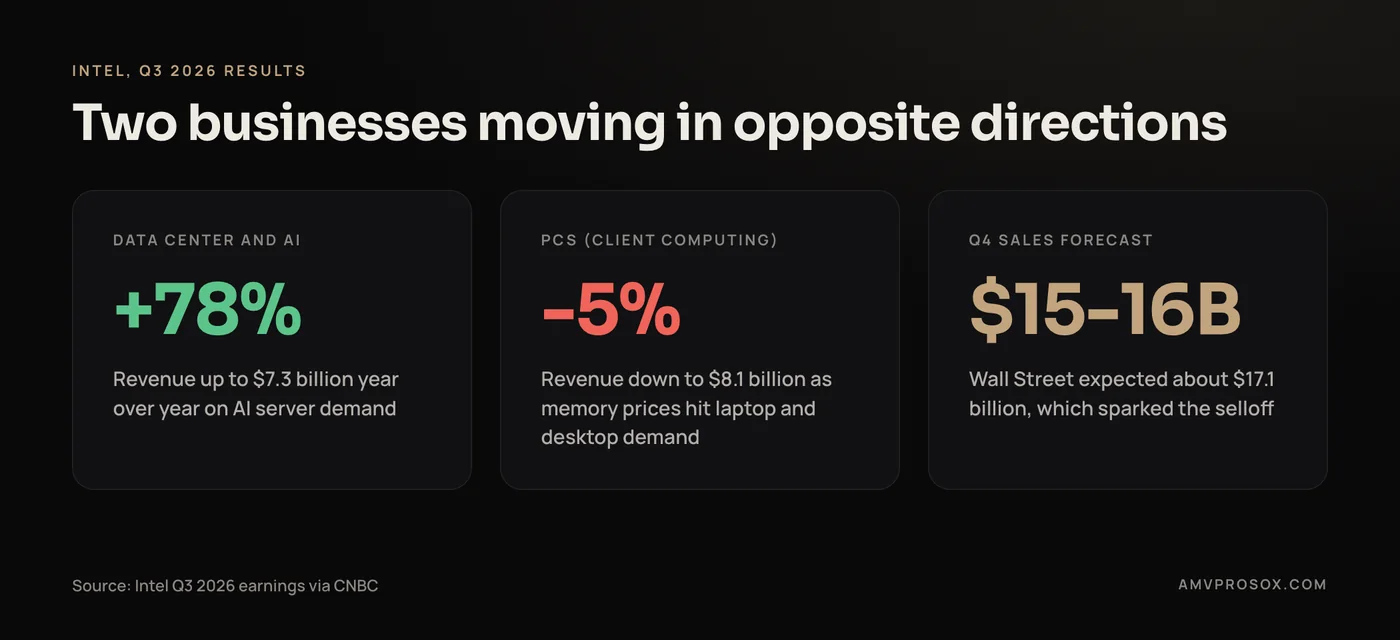
- Intel's data center and AI revenue rose 78% to $7.3 billion, but its PC business fell 5% to $8.1 billion as soaring memory prices cut demand.
- Amazon's free cash flow was negative $42.4 billion over the 12 months to September, compared with positive $14.8 billion a year earlier, after quarterly capital spending more than doubled to about $77 billion.
- The Nasdaq Composite fell 2.86% on October 30 and about 5.2% in October, its worst month since March 2025.
- AI demand is still growing, with AWS revenue up 39%, so the selloff is about whether AI spending will pay back, not whether people use AI.
On Friday, October 30, 2026, Wall Street had its worst day for tech stocks in nearly five months. Intel lost more than a quarter of its value in a single session, AMD and Dell followed it down, and the Nasdaq 100 was on course to shed more than $1 trillion in market value in one day, according to InformationWeek. By the closing bell, the Nasdaq had finished its worst month since March 2025.
The trigger was not one bad company. It was a question that investors have been quietly asking all year and finally asked out loud: Big Tech is spending hundreds of billions of dollars on AI, so when does that money come back?
This guide explains what happened in plain English, why Intel crashed, why Amazon's numbers spooked the market, whether this is the AI bubble popping, and what it means for your gadgets, your business and your website. Market figures come from Yahoo Finance's live market coverage, CNBC's Intel earnings report and The Motley Fool's market data. This is news and analysis, not investment advice.
The AI Selloff in 60 Seconds
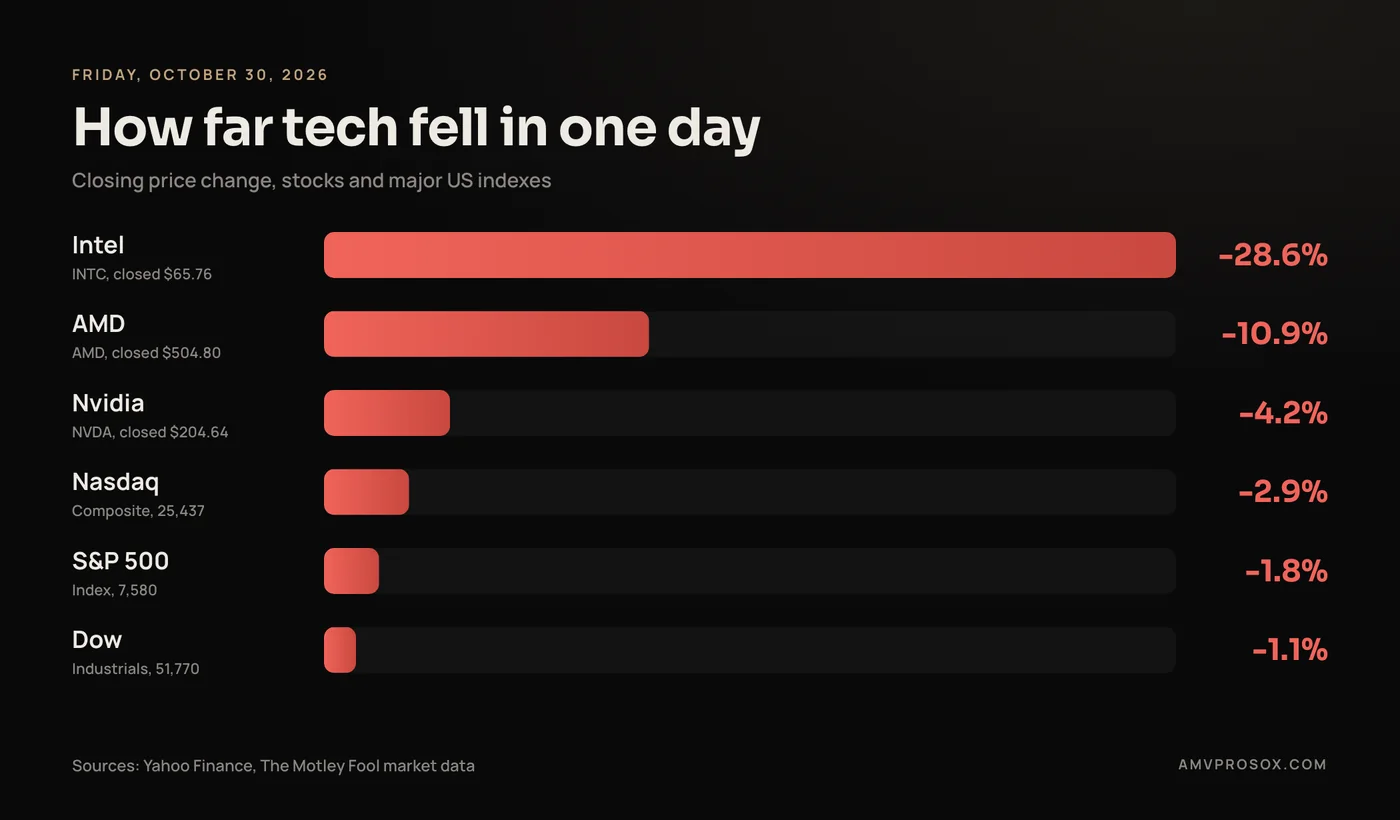
- Intel closed at $65.76, down 28.58%, one of its steepest single-day drops in decades. About 448 million shares traded, more than four times the normal volume.
- AMD fell 10.88% and Nvidia fell 4.22%. Dell dropped about 13%, according to 24/7 Wall St.
- Amazon slid about 7% before the opening bell after missing earnings estimates and reporting that its free cash flow had turned deeply negative.
- The Nasdaq Composite closed at 25,437, down 2.86%, its worst day since June 5. The S&P 500 fell 1.82% and the Dow fell 1.09%.
- For the month of October, the Nasdaq lost about 5.2% and the S&P 500 lost 1.2%, while the Dow actually gained 1.5%. Tech and communication services were the only sectors that fell in October.
That last point matters. This was not a market-wide panic. Money moved out of tech specifically, and the reason was AI spending.
Why Did Intel Stock Crash 29%?
Here is the strange part: Intel actually beat expectations for the quarter. Revenue for the third quarter of 2026 was $16.51 billion, up 21% from a year earlier, and adjusted earnings were 52 cents a share against 40 cents expected, CNBC reported.
The problem was the forecast. Intel told investors to expect fourth-quarter revenue of $15 billion to $16 billion, while Wall Street was expecting about $17.1 billion. It guided adjusted earnings to 25 cents a share, far below the 43 cents analysts had penciled in. Stock prices are bets on the future, so a weak forecast hurts far more than a good past quarter helps.
Three things dragged the outlook down:
- PCs are getting too expensive to sell. Intel's client computing business, the chips inside laptops and desktops, fell 5% to $8.1 billion. CEO Lip-Bu Tan said customers "began signaling a PC slowdown based on the memory prices and availability." CFO David Zinsner said he expects the slowdown to last at least through the first half of 2027.
- A factory accident. An explosion at an Intel plant in Israel earlier in October killed two workers and forced an extended shutdown. Intel estimates it will cost about $600 million in lost revenue over two quarters.
- Heavy spending on its comeback. Intel is pouring money into new factories in Arizona and Ohio and still has no major outside customer for its chip-making business, although Tan said a couple will be announced over the next two quarters.
Meanwhile, Intel's data center and AI business grew 78% to $7.3 billion. So Intel is a perfect picture of 2026 tech: the AI side is booming, and everything that competes with AI for parts is getting squeezed. It is also worth knowing that Intel stock had already more than doubled this year before the report, which made the fall sharper.
Why Are Laptops Getting More Expensive?
This is the part of the story that touches everyone. AI data centers need enormous amounts of memory, and the factories that make memory chips have shifted production toward AI servers because those customers pay more. That leaves less memory for laptops, desktops and phones, and the price goes up.
Market research firm TrendForce projected that PC memory contract prices would more than double in the first quarter of 2026, the largest quarterly jump on record. Laptop makers passed those costs on, buyers held back, and Gartner forecasts that worldwide PC shipments will fall about 10.4% in 2026 as people keep their old machines longer. Counterpoint Research says global PC shipments were already down 4% in the second quarter.
If you have noticed that new laptops cost more for the same specs this year, this is why. Apple's new OLED MacBook Pro costs more than the comparable mini-LED model, as I covered in the new MacBook Pro 2026 breakdown, and premium AI laptops like Nvidia's RTX Spark machines start at $2,599.
Why Amazon's Numbers Scared Wall Street
Amazon reported third-quarter earnings of $1.89 a share, just short of the $1.97 expected, on revenue of $201.9 billion. A small miss would normally be shrugged off. What caught attention was the cash.
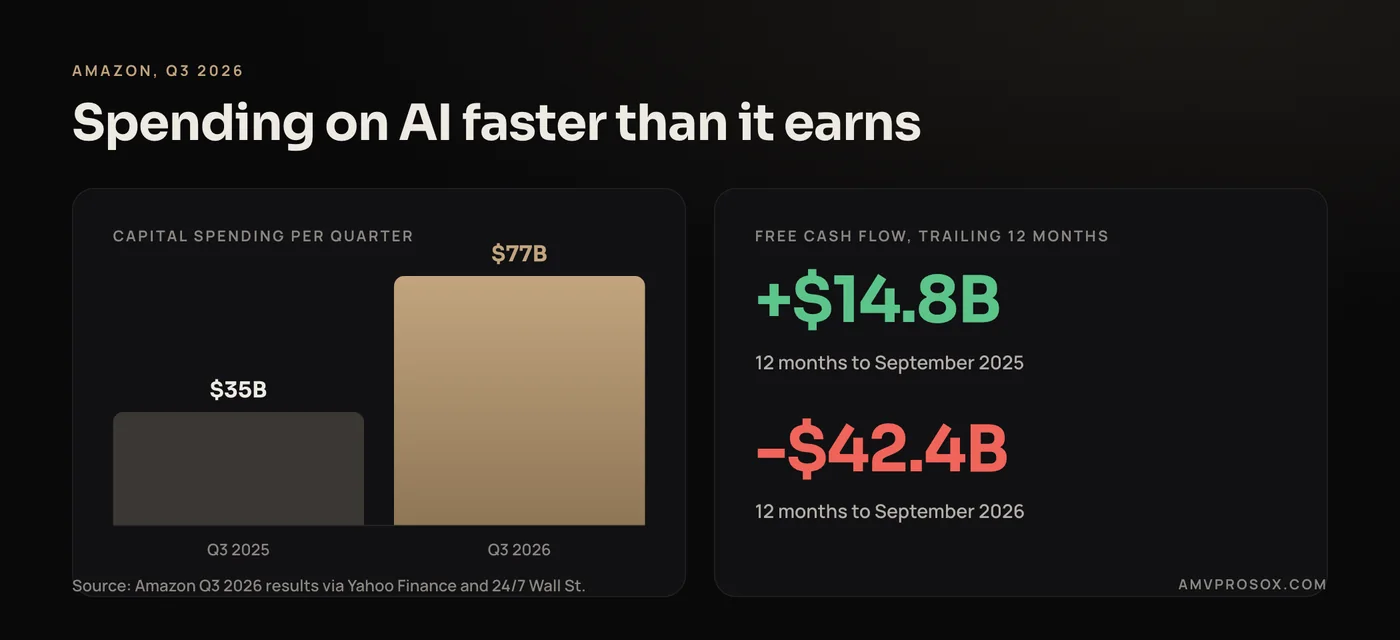
Free cash flow is the money left over after a company pays for its operations and its investments. Over the 12 months to September, Amazon's free cash flow was negative $42.4 billion. A year earlier it was positive $14.8 billion. The previous record low, set in 2022, was about negative $23 billion.
The reason is spending. Amazon spent about $77 billion on property and equipment in the July to September quarter alone, up from $35 billion a year earlier, mostly on data centers and AI chips. It is on track for roughly $220 billion of capital spending in 2026 and told investors it will spend "meaningfully more" in 2027.
To be clear, Amazon is still profitable and its cloud business is booming. AWS revenue grew 39%, and its backlog of signed contracts reached $578 billion, according to 24/7 Wall St. The worry is not that customers are leaving. It is that the bill for building AI keeps growing faster than the revenue it brings in.
Amazon is not alone. Alphabet sold off on Thursday over rising AI costs and concerns about its advertising business, and back in July it reported its first quarter of negative free cash flow as a public company while raising its 2026 capital spending plan to $195 billion to $205 billion. Meta is now more than 20% below its 52-week high.
Is the AI Bubble Bursting?
Not exactly, at least not yet. A bubble bursts when demand turns out to be imaginary. The numbers from this week say the opposite: people and companies are using AI more than ever.
| Signs AI demand is real | Signs investors are nervous |
|---|---|
| AWS revenue up 39%, with a $578 billion backlog | Amazon free cash flow at negative $42.4 billion |
| Intel data center and AI revenue up 78% | Intel PC revenue down 5% as memory costs bite |
| Oracle committed to Nvidia Vera Rubin systems at multi-gigawatt scale | Nasdaq down about 5.2% in October |
| New AI models launch almost weekly | Big Tech plans to spend even more in 2027 |
What changed is patience. For two years, investors rewarded any company that spent heavily on AI. Now they want proof that the spending turns into profit. Keith Lerner, chief investment officer at Truist, said "the corrective process may not be complete," while adding that the longer-term tech uptrend remains intact.
My read, as someone who builds with these tools every day: this looks like a reality check, not a collapse. The AI products are useful and getting better fast, as you can see in this month's AI model releases. But the companies building the infrastructure are spending at a pace that has to be justified, and the market just reminded them of that.
What the AI Selloff Means for You
If you are buying a laptop or phone
Expect prices to stay high into 2027 because memory is still tight. If you need a new machine for work, holiday sales may be the best pricing you see for a while. If your current device runs fine, there is no shame in keeping it another year. Millions of people are doing exactly that.
If you own tech stocks
I am a web developer, not a financial advisor, so I will not tell you what to buy or sell. The only general point worth making is that days like October 30 are a reminder of how concentrated many portfolios are in a handful of tech companies. If that worries you, talk to a licensed advisor.
If you run a small business
This is where it gets practical. Many AI tools are priced low right now because providers are competing for users, and their parent companies are absorbing huge costs. As investors push for returns, some of those prices will rise and some free tiers will shrink.
- Audit your AI subscriptions. List every AI tool your team pays for and cancel anything nobody used last month.
- Avoid building your whole business on one AI tool. Keep your data, content and customer lists in places you control, so a price change does not break your operations.
- Spend on AI that pays back. A chatbot that answers real customer questions or a workflow that saves your team hours each week is worth it. AI added because it sounds modern is not.
- Own your traffic. When ad platforms and AI search change their rules, a fast website, solid SEO and an email list keep customers coming. My guide to Google AI Mode and SEO for small businesses covers where search is heading.
If you run a website or online store
Because people are keeping laptops and phones longer, more of your visitors are on older, slower devices. That makes site speed more important, not less. Heavy scripts, oversized images and bloated themes cost you sales on older hardware. With Black Friday weeks away, this is a good moment to work through a Black Friday and Cyber Monday website checklist. And if your site runs on PHP, make sure it is patched against the PHP2Shell vulnerability, which was the other big tech story this week.
What to Watch Next
- November 2 to 5: Palantir, Cloudflare and Atlassian report quarterly results, a test of whether software companies are earning money from AI.
- November 3: US midterm elections, which could shape AI regulation, data privacy rules and tech spending.
- November 3 to 4: AMD, Arm, Qualcomm and Arista Networks report earnings. AMD and Qualcomm will show how deep the PC and phone slowdown goes.
- Memory prices: Any sign that memory supply is easing would help PC makers, laptop prices and Intel.
Frequently asked questions
Why did Intel stock drop so much on October 30, 2026?
Intel fell 28.58% because its fourth-quarter forecast of $15 billion to $16 billion in revenue came in well below the roughly $17.1 billion Wall Street expected. High memory prices are hurting PC demand, a factory explosion in Israel will cost about $600 million in revenue, and the company is spending heavily on new plants. Its third-quarter results actually beat estimates.
Is the AI bubble bursting?
Not based on current evidence. Demand for AI keeps rising, with AWS revenue up 39% and Intel's data center and AI sales up 78%. What is changing is investor patience with the cost. Companies like Amazon and Alphabet are spending more than their operations bring in, and markets now want proof that the spending will pay off.
Did Amazon lose money in Q3 2026?
No. Amazon was profitable, earning $1.89 a share on $201.9 billion in revenue. Its free cash flow was negative $42.4 billion over 12 months because it spent so much on AI data centers, about $77 billion in the third quarter alone. Negative free cash flow means it invested more than its operations generated, not that the business lost money.
Why are laptop prices going up in 2026?
Memory chips are in short supply because AI data centers are buying huge amounts of them at higher prices. TrendForce projected PC memory prices would more than double in the first quarter of 2026. Laptop makers passed those costs on, and Intel expects the PC slowdown to continue at least through the first half of 2027.
How bad was October 2026 for tech stocks?
The Nasdaq Composite fell about 5.2% in October, its worst month since March 2025, and dropped 2.86% on October 30 alone, its worst day since June 5. The Dow rose 1.5% for the month, so the selling was focused on technology and communication services rather than the whole market.
Will AI tools get more expensive for businesses?
Some likely will. AI providers are spending record amounts on infrastructure, and investors are pressing for returns, which usually means higher prices or smaller free tiers over time. Businesses can protect themselves by auditing subscriptions, keeping data portable and investing in assets they own, like their website and email list.
The Bottom Line
The AI selloff of October 2026 is not the end of AI. It is the moment the bill arrived. Intel showed how AI demand is squeezing everything else, Amazon showed how expensive the build-out has become, and investors showed they want results, not just ambition. For everyday buyers, that means pricier laptops for a while. For businesses, it means spending on AI and technology that clearly earns its keep.
If you want a website that loads fast on any device, AI features that actually save time, or an online store ready for the holiday rush without paying for tools you do not need, send me the details of your project. I work with businesses across the US, Europe and beyond, and you can browse my past projects and case studies first. I reply within 24 hours.