Brave Lawsuit: NYT and 3 Newspapers Sue Over AI Scraping and Paywalls
By Eoin Villarin, 2026-11-03
The New York Times, Daily News, Chicago Tribune and Orlando Sentinel sued Brave on Nov 2, 2026, over AI scraping, API data sales and a paywall blocker.
Who sued Brave, and what does the lawsuit claim?
On November 2, 2026, The New York Times Company and, in a second suit, the Daily News, Chicago Tribune and Orlando Sentinel sued Brave Software in the Southern District of New York (cases 26-cv-9549 and 26-cv-9554). Each complaint alleges direct, contributory and vicarious copyright infringement through Ask Brave, the Brave Search API and the Brave Browser, a DMCA anti-circumvention violation tied to the Paywall blocker, and unjust enrichment over ad replacement. The publishers seek damages and a permanent injunction; the claims are unproven allegations and Brave had not commented publicly as of November 3.
Key takeaways
- The New York Times Company and, separately, the Daily News, Chicago Tribune and Orlando Sentinel sued Brave Software on November 2, 2026, in the Southern District of New York.
- Each complaint lists five counts: direct, contributory and vicarious copyright infringement, DMCA anti-circumvention under 17 U.S.C. 1201, and unjust enrichment under New York law.
- The complaints allege the Brave Index covers over 30 billion web pages and name Anthropic, Perplexity, Mistral, xAI and Cohere as Brave Search API customers, though none of them is a defendant.
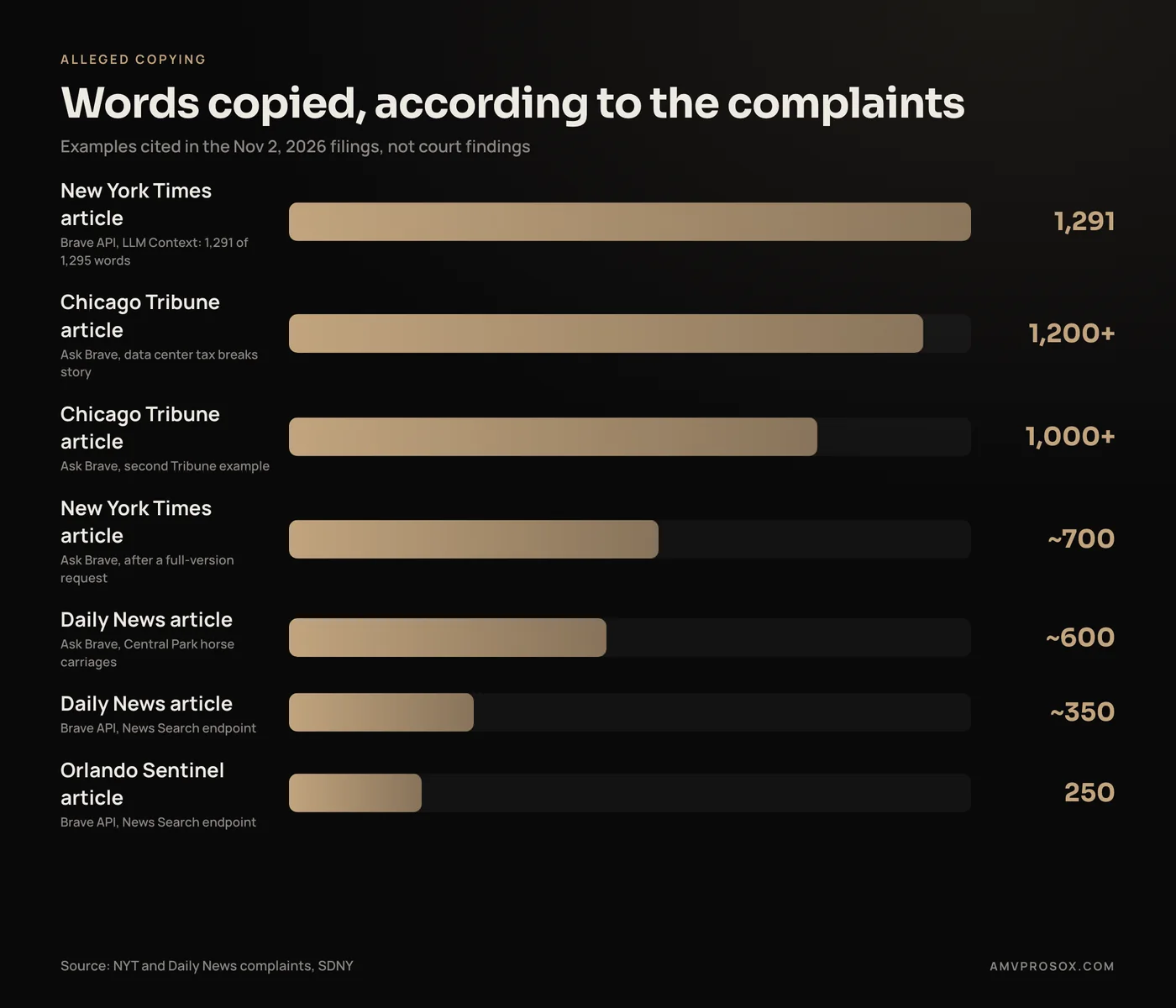
- In one Times example, the Brave API's LLM Context endpoint allegedly returned 1,291 of the 1,295 words in an article.
- The Times says it sent cease-and-desist letters to Brave CEO Brendan Eich on August 11, 2025, and April 13, 2026, and that Brave ignored both.
- Brave is also in a separate dispute with News Corp, which countersued it on July 21, 2026, in federal court in Oakland.
The New York Times Company and three other newspapers, the Daily News, the Chicago Tribune and the Orlando Sentinel, sued Brave Software on November 2, 2026. They accuse the maker of the Brave browser of scraping their journalism, feeding it into AI answers and selling access to it through the Brave Search API. The complaints also target a browser setting called "Paywall blocker."
This goes beyond one browser. Brave says it is one of only three US companies running an independent search engine at scale, according to Reuters, and the complaints name five well-known AI companies as its customers. If your business depends on people visiting your pages, this case is about an open question: who can copy your content for AI, and how you can control it.
The facts below come from the two complaints, plus reporting by TheWrap, heise online, Reuters and PPC Land. Everything the publishers say is an allegation, and no court has ruled on it.
Brave lawsuit at a glance
| Item | Details |
|---|---|
| Filed | November 2, 2026 |
| Court | US District Court for the Southern District of New York |
| Cases | The New York Times Co. v. Brave Software (26-cv-9549); Daily News, LP et al. v. Brave Software (26-cv-9554) |
| Defendant | Brave Software, Inc. only |
| Products named | Ask Brave, Brave Search API, Brave Browser (Paywall blocker, ad blocking, Brave News, Leo), Brave Ads |
| Claims | Copyright infringement (direct, contributory, vicarious), DMCA anti-circumvention, unjust enrichment |
| Relief sought | Damages, restitution of profits, a permanent injunction and legal fees, with no dollar figure stated |
| Brave's response | No public statement found as of November 3, 2026 |
Who sued Brave, and where?
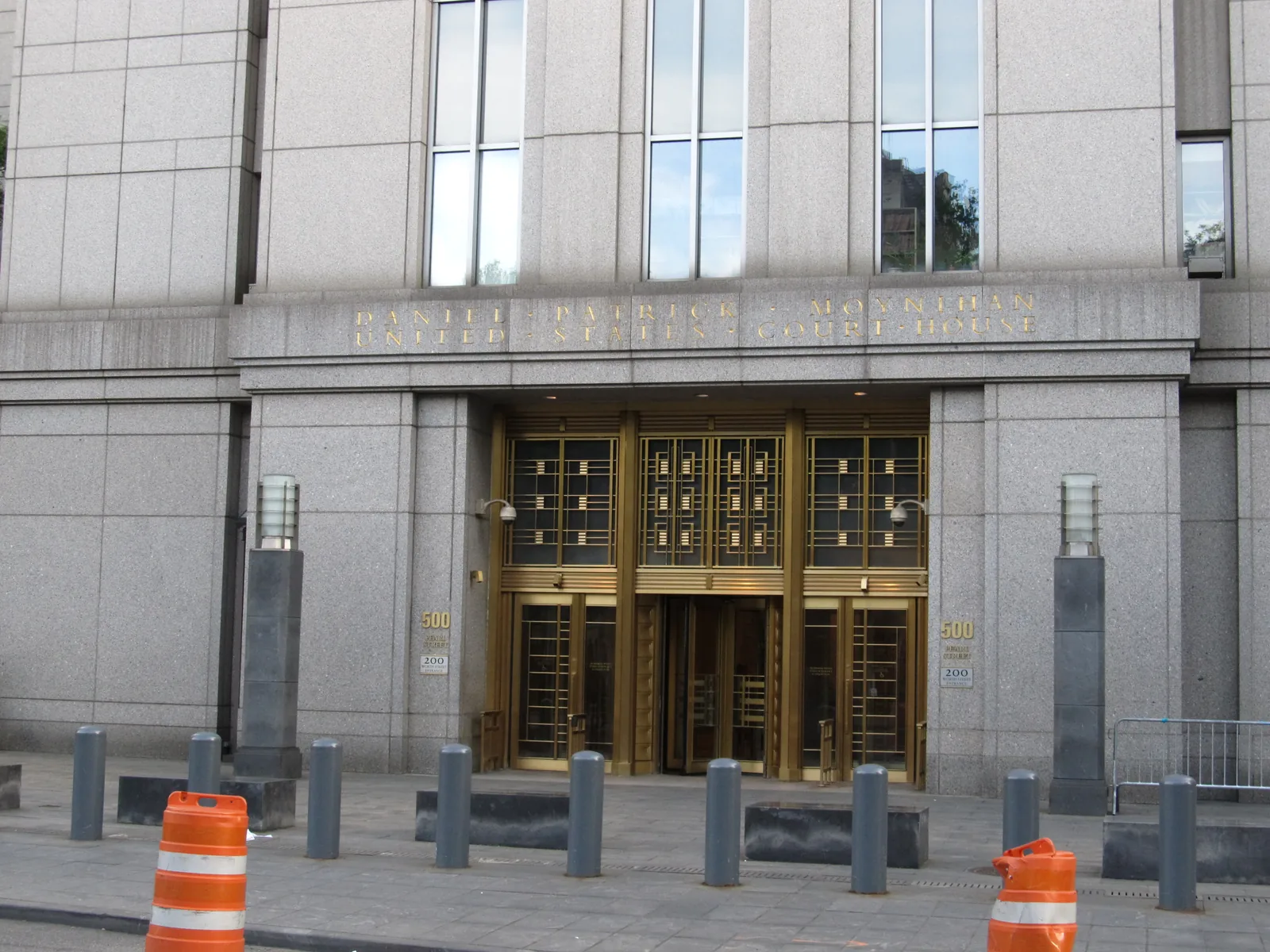
Two complaints were filed the same day in the Southern District of New York. The Times filed alone in a 72-page complaint. The Daily News, the Chicago Tribune and the Orlando Sentinel filed together in a 69-page complaint. Both are signed by Steven Lieberman of Rothwell, Figg, Ernst & Manbeck, and both demand a jury trial.

The Times says it owns over 10 million registered copyrighted works, and the other three papers say their registered issues contain more than 2 million articles. Lieberman, speaking for the three papers, told TheWrap: "Buying stolen goods secondhand doesn't make them legitimate."
The Times also says it warned Brave twice, in letters to CEO Brendan Eich dated August 11, 2025, and April 13, 2026, and that Brave ignored both. The second complaint does not describe similar letters.
What does the lawsuit say Brave did?
The Brave Index and an unnamed crawler
According to the lawsuits, Brave built its search index by crawling and copying web pages, and they quote Brave describing it as "over 30 billion webpages." The publishers say Brave never disclosed the name of its crawler, so site owners had no way to block it. They call Brave both a "burglar" and an AI "fence."
Ask Brave
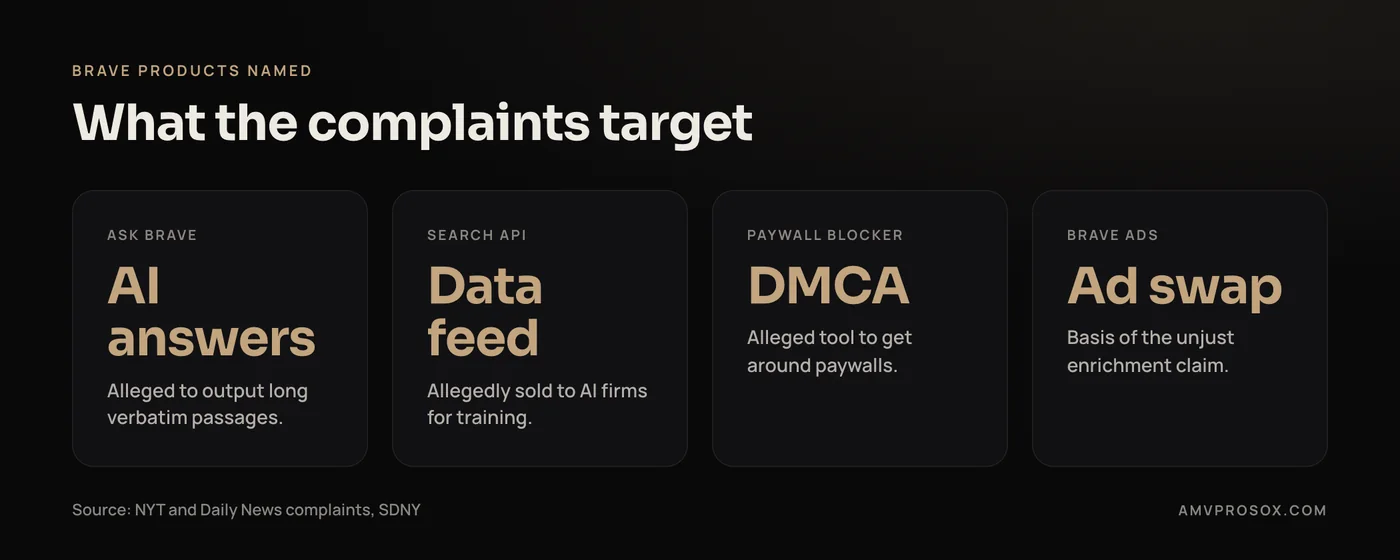
Ask Brave is the AI answer feature in Brave Search, which the complaints say replaced a tool called Summarizer in 2025. The publishers allege it pulls pages from the index and outputs long verbatim passages. In one Times example, it allegedly produced about 87% of a paywalled article. The second complaint cites over 1,200 words from a Chicago Tribune story and nearly 600 words from a Daily News story.
The Brave Search API
The complaints say Brave sells index access to AI companies for training models and grounding answers, naming Anthropic, Perplexity, Mistral, xAI and Cohere as customers based on Brave's own marketing. The endpoints singled out are News Search, Web Search, LLM Context and Answers. In one Times example, LLM Context allegedly returned 1,291 of an article's 1,295 words.
The Brave Browser
The browser claims center on "Paywall blocker," a setting the complaints say Brave describes as letting users "Bypass Paywalls" once switched on. Both complaints show screenshots of an article blocked in another browser and readable in Brave. They also say Brave strips publishers' ads by default and shows its own Brave Ads. Brave News and the Leo assistant are mentioned, but the copying examples focus on Ask Brave and the API.
What legal claims are in the Brave lawsuit?
Both complaints list the same five counts:
- Direct copyright infringement under 17 U.S.C. 501, covering the index, Ask Brave, the API and paywalled pages copied by the browser.
- Contributory infringement, alleging Brave induced users and AI customers to copy the content.
- Vicarious infringement, alleging Brave controlled and profited from that copying.
- DMCA anti-circumvention under 17 U.S.C. 1201(a)(1)(A) and 1201(a)(2), aimed at the Paywall blocker.
- Unjust enrichment under New York law, over Brave replacing publishers' ads with its own, which the complaints say does not depend on any copying.
There is no separate trademark or unfair competition count, although the Times complaint says Brave News uses its trademark without authorization. The publishers seek statutory and actual damages, restitution of profits, a permanent injunction, legal fees and DMCA remedies, but name no dollar figure. They also allege Brave has made more than $100 million by reselling publishers' work.
What has Brave said about the lawsuit?
As of November 3, 2026, I could not find a public statement from Brave about these suits. TheWrap reported that Brave did not immediately respond to a request for comment, and PPC Land reported that Brave had not yet answered either complaint in court.


Brave has defended its approach in a related fight. Suing News Corp, it argued that indexing website content is fair use, something "which all search engine operators must do to exist," as Semafor reported. Brave's crawler help page says its bot does not advertise a separate user agent, and that if Googlebot cannot crawl a page, Brave's crawler will not crawl it either.
Is this the only lawsuit against Brave over AI scraping?
No. Brave has been fighting News Corp, owner of The Wall Street Journal and the New York Post, since early 2025:
- February 27, 2025: News Corp sent Brave a cease-and-desist letter, according to The Register.
- March 2025: Brave sued News Corp in San Francisco federal court seeking a declaration that its practices are lawful, Reuters reported.
- June 2025: the parties jointly dismissed that case without prejudice, Bloomberg Law reported.
- May 2026: Brave filed a revised complaint after deal talks failed, according to Reuters.
- July 21, 2026: News Corp countersued in federal court in Oakland, alleging Brave secretly scraped and resold its articles. TheWrap reported it wants an injunction, damages and destruction of the databases involved.
How do AI search and answer engines use publisher content?
Most AI search tools use retrieval augmented generation, or RAG. The system pulls relevant pages from a search index, then hands that text to a language model, which writes the answer. The complaints say this is how their articles end up in Ask Brave's replies.
A classic search result shows a link and a snippet, and the click goes to the publisher. An AI answer can summarize or quote a page so fully that the reader never clicks. The Times complaint cites a TollBit study finding that AI bots send 95.7% less referral traffic than traditional Google search.
How do paywalls and robots.txt work, and what does "bypassing" mean here?
A robots.txt file tells crawlers which URLs they may visit. Google's documentation says it is up to each crawler to obey it, and that robots.txt does not keep a page out of search results; noindex or password protection does. In practice, robots.txt only works when a crawler identifies itself and chooses to follow it.
That is the heart of the crawler dispute. The publishers say Brave crawled without identifying itself. Reading Brave's help page, my understanding is that a site cannot shut out Brave's crawler in robots.txt without also shutting out Googlebot, which few publishers can afford.
A paywall is different: it is a lock, not a request. The Times says its paywall is a technological measure that controls access to its works, the key element of a DMCA section 1201 claim. The publishers allege the Paywall blocker is a tool built to get around that lock, and the statute separately bans offering such tools to the public. Whether a news paywall qualifies is for the court to decide.
If you run a paywalled site, Google's paywalled content structured data uses the isAccessibleForFree property to mark locked sections. It helps Google tell an intentional paywall apart from cloaking, which breaks its spam policies.
Other publisher lawsuits against AI companies
| Filed | Plaintiffs | Defendant |
|---|---|---|
| Late 2023 | The New York Times (heise) | OpenAI and Microsoft |
| February 2025 | Publishers including Condé Nast, Forbes and The Atlantic (BNN Bloomberg) | Cohere |
| December 2025 | The New York Times and the Chicago Tribune (Bloomberg Law) | Perplexity |
| July 2026 | News Corp, as a countersuit | Brave |
| November 2026 | The New York Times; Daily News, Chicago Tribune, Orlando Sentinel | Brave |
The Perplexity case has a familiar thread. According to The Decoder, the Times says it tried robots.txt, then a hard block, and alleges Perplexity kept reaching its site with undisclosed user agents. The Brave suits differ by targeting an index supplier.
What happens next in the Brave case?
Brave has to respond first. Under Federal Rule of Civil Procedure 12, a defendant generally has 21 days after being served to answer, or 60 days from the request if it waives formal service. It can also ask the court to dismiss some or all claims instead.
The News Corp case continues separately in California. I will not guess how any of this ends: the court has made no findings, and every claim above remains an allegation.
What it means for publishers and website owners
This is not legal advice, and if you think your content has been copied, speak to a lawyer. But there are practical steps any site owner can take:
- Audit your robots.txt. Know which named AI crawlers you allow or block. My guide to generative engine optimization lists the main ones and the visibility trade-off.
- Treat robots.txt as a request, not a lock. For enforcement, add bot rules at the server or CDN level, and use noindex for pages that should stay out of indexes.
- Check how your paywall is built. If full article text sits in the page source and is only hidden by a script, more tools can read it than you might expect.
- Write down your licensing terms. Clear terms of service and a licensing contact make your position easier to state.
- Decide what you want from AI search. Blocking everything can cost you citations in AI answers. My post on making a website agent-ready covers the opposite approach.
Frequently asked questions
Who is suing Brave?
The New York Times Company filed one lawsuit, and the Daily News, Chicago Tribune and Orlando Sentinel filed a second, both on November 2, 2026, in the Southern District of New York.
Are AI companies like Anthropic or Perplexity being sued in this case?
No. The complaints name Anthropic, Perplexity, Mistral, xAI and Cohere as alleged Brave Search API customers, but none of them is a defendant in these two suits.
Does the Brave browser bypass paywalls?
The complaints allege that a setting called Paywall blocker, once switched on, lets users read paywalled articles without logging in, and they include screenshots. Brave had not commented publicly on these suits as of November 3. No court has decided whether the feature violates the DMCA.
How much money do the publishers want?
Neither complaint names a dollar figure. Both ask for statutory damages, actual damages, restitution of profits, a permanent injunction and legal fees. The Times says its April 2026 letter warned Brave of enhanced statutory damages of up to $150,000 per infringement.
Can I block Brave's crawler with robots.txt?
Brave says its crawler does not use a separate user agent and will not crawl pages that Googlebot cannot crawl, so your Googlebot rules effectively apply to it. To remove a page from Brave Search, Brave points to the noindex directive. The publishers say Brave gave site owners no way to block its crawler.
The bottom line
Four newspapers accuse Brave of building an index from their journalism, serving it through Ask Brave, selling it to AI companies and helping readers past their paywalls. Brave has not commented publicly, and nothing has been proven. For publishers, it is a reminder that robots.txt, paywalls and licensing terms protect content in different ways.
If you want help setting up robots.txt and AI crawler rules, adding paywall-friendly structured data, or deciding which AI tools should read your site, I build and maintain sites with these controls in mind. See some of that work in my case studies, or send me a message and we can look at your setup together.