ICE Explained: What to Know About Immigration and Customs Enforcement in 2026
By Eoin Villarin, 2026-11-02
A neutral guide to ICE as of November 2026: who leads it, its 2025 and 2026 funding, dated detention data, recent court rulings, the detainee locator and Form I-9 rules.
What is ICE and what is happening with it in November 2026?
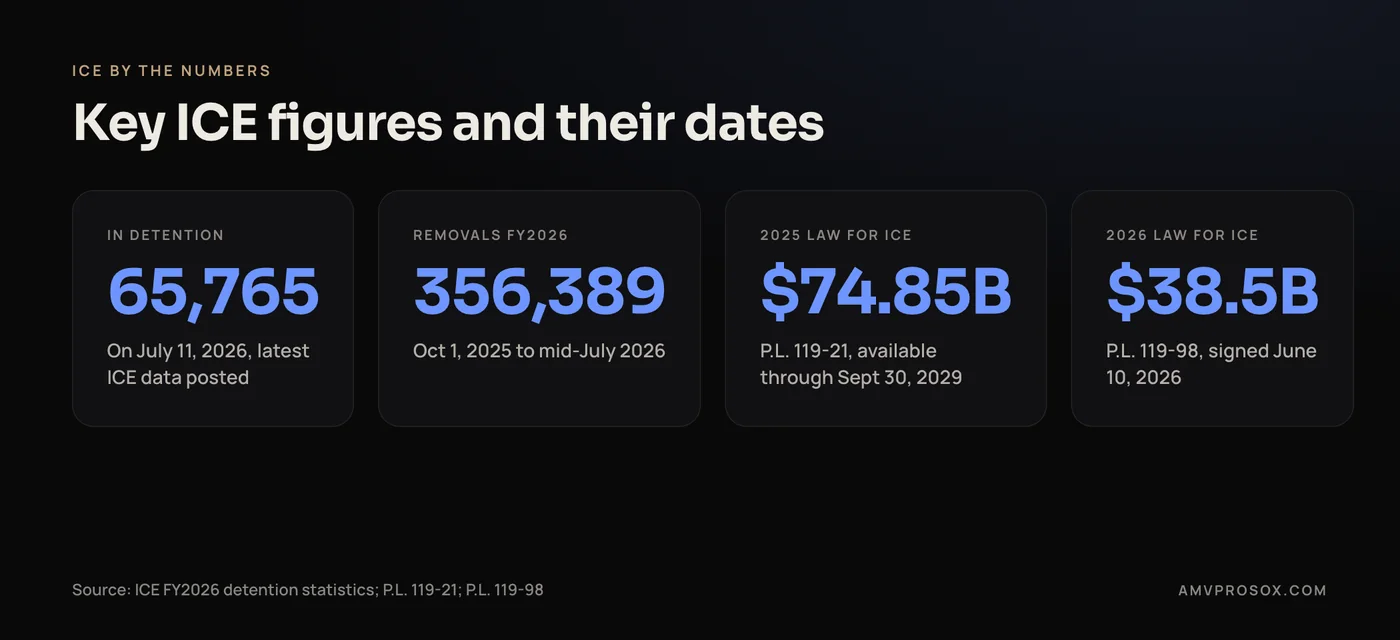
U.S. Immigration and Customs Enforcement (ICE) is a Department of Homeland Security agency created in 2003 that enforces immigration law inside the country, runs detention and removals, and investigates crimes through Homeland Security Investigations. As of November 2, 2026, David J. Venturella leads it as the senior official performing the duties of the director, after the White House withdrew nominee Lance Schroyer on September 17. Laws signed July 4, 2025 and June 10, 2026 gave ICE $74.85 billion and about $38.5 billion in multi-year funding, and ICE's latest posted data show 65,765 people in detention on July 11, 2026.
Key takeaways
- ICE was created in 2003 inside the Department of Homeland Security from parts of the former INS and U.S. Customs Service.
- David J. Venturella leads ICE as the senior official performing the duties of the director after the White House withdrew Lance Schroyer's nomination on September 17, 2026.
- The July 4, 2025 reconciliation law (P.L. 119-21) gave ICE $45 billion for detention and $29.85 billion for hiring and operations, available through September 30, 2029.
- The Secure America Act (P.L. 119-98), signed June 10, 2026, added about $38.5 billion for ICE, including $7.45 billion for Homeland Security Investigations.
- ICE's latest posted data show 65,765 people in detention on July 11, 2026, and 356,389 removals in fiscal year 2026 through mid-July.
- On October 1, 2026, the Supreme Court agreed to review the administration's policy of denying bond hearings to certain detained immigrants.
U.S. Immigration and Customs Enforcement, better known as ICE, has been a regular part of the news in 2026. Since September, the White House withdrew its nominee to run the agency, the Supreme Court agreed to hear a major detention case, and federal courts issued new rulings on bond hearings and on how agents conduct stops.
ICE is also operating with large multi-year funding from laws signed in July 2025 and June 2026. If you follow the news, have a relative in custody or hire workers, it helps to know how the agency works and where its numbers come from.
Facts come from ice.gov, dhs.gov, the laws on govinfo.gov, the Congressional Research Service (CRS), TRAC Immigration, AP, Reuters and NPR, linked inline. Contested claims are attributed, and nothing here is legal advice.
ICE at a glance (November 2026)
| Question | Short answer |
|---|---|
| What is it? | A law enforcement agency inside the Department of Homeland Security (DHS) |
| Created | 2003 |
| Main parts | Enforcement and Removal Operations (ERO), Homeland Security Investigations (HSI), Office of the Principal Legal Advisor (OPLA) |
| Who leads it? | David J. Venturella, senior official performing the duties of the director |
| Extra funding | $74.85 billion (2025 law) and about $38.5 billion (2026 law), available through September 30, 2029 |
| People in detention | 65,765 on July 11, 2026, the latest ICE data posted |
| Find a detainee | locator.ice.gov |
What is ICE and when was it created?
ICE is an operational component of DHS. The department describes ICE as carrying out "the criminal and civil enforcement of federal laws governing border control, customs, trade, and immigration."
The agency was created in 2003 by merging the investigative and interior enforcement parts of the former U.S. Customs Service and the Immigration and Naturalization Service (INS), as DHS began operating under the Homeland Security Act of 2002. ICE says it has more than 400 offices in the US and abroad.
What do ERO, HSI and OPLA do?
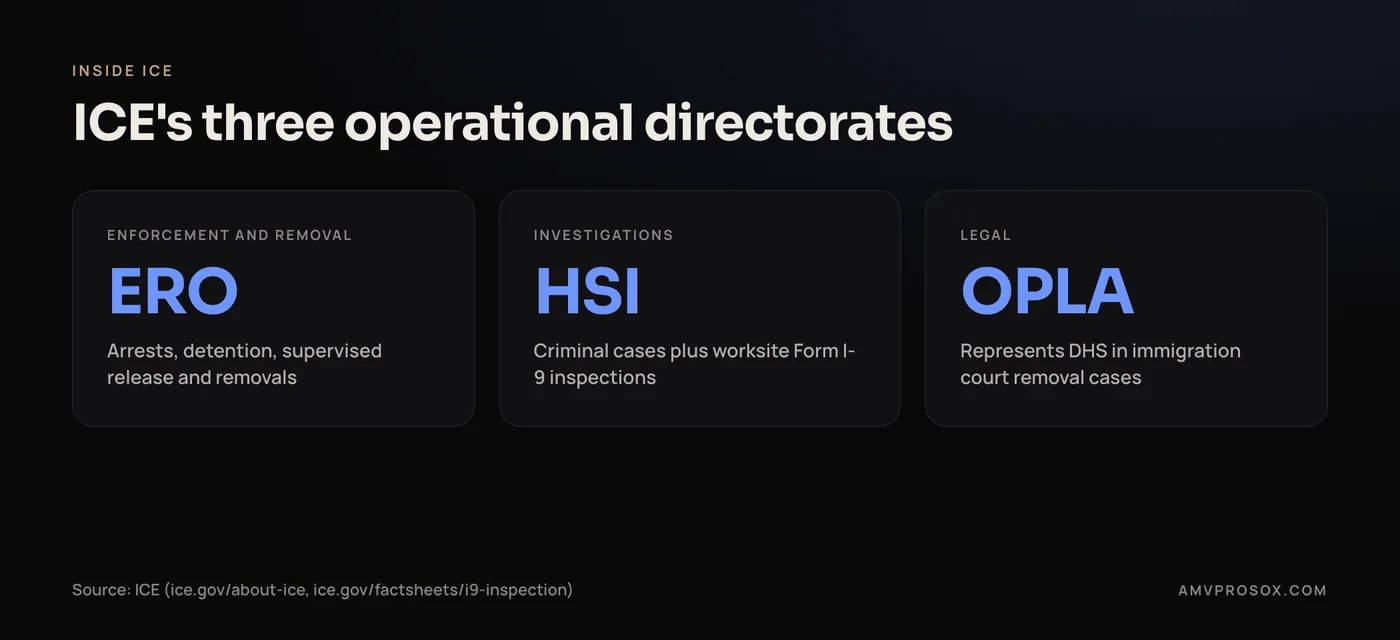
ICE has three operational directorates, according to its About page:
- Enforcement and Removal Operations (ERO) handles civil immigration enforcement inside the country: arrests, transportation, detention, bond, supervised release and removals to more than 150 countries.
- Homeland Security Investigations (HSI) is DHS's main criminal investigative arm, covering cases such as narcotics, human trafficking, money laundering and cybercrime. It has more than 8,700 employees and 237 US offices.
- Office of the Principal Legal Advisor (OPLA) is the largest legal program in DHS, with more than 3,600 attorney positions. Its lawyers represent the government in immigration court removal cases.
Who leads ICE right now?
ICE's leadership page lists David J. Venturella as "Senior Official Performing the Duties of the Director." His ICE biography says he joined the INS in 1986, retired as ERO's executive associate director in 2012, and worked at GEO Group from 2012 to 2023. He has led ICE since June, after Todd Lyons stepped down as acting director at the end of May, NPR reported.
President Trump nominated former Oklahoma state trooper Lance Schroyer as director on June 27, and the White House withdrew the nomination on September 17 without giving a reason. AP reported that Senate Homeland Security Chairman Rand Paul had held off on a hearing while waiting for DHS information about deaths during ICE operations, and that ICE has had no Senate-confirmed director since the Obama administration. I found no new nominee announced as of November 2.
ICE reports to DHS Secretary Markwayne Mullin, whom the Senate confirmed 54-45 in March 2026 to succeed Kristi Noem.
How big is ICE's budget in 2026?
ICE's About page describes an annual budget of about $8 billion. Two reconciliation laws add large multi-year sums on top:
- 2025 law: P.L. 119-21, signed July 4, 2025, gave ICE $45 billion for detention capacity and $29.85 billion for hiring, training and operations, a total of $74.85 billion available until September 30, 2029.
- 2026 law: The Secure America Act (P.L. 119-98), signed June 10, 2026, added $7.45 billion for HSI and $31.075 billion for ICE enforcement, about $38.5 billion of its $69.545 billion total, also available through September 30, 2029.
The 2026 law ended the longest funding lapse in DHS history. DHS funding lapsed on February 14, 2026, and the annual DHS law signed April 30 left out ICE and Border Patrol, so their lapse lasted 116 days, according to CRS. NPR reported that Democratic proposals such as requiring judicial warrants for home entry were not included, while House Budget Chair Jodey Arrington, a Republican, called it regular funding.
A stopgap law signed September 2 funds the government through December 11, 2026, and ICE continues on reconciliation money, a September 30 CRS report says. Staffing also grew: ICE said on January 3 that it hired more than 12,000 officers and agents in under a year, growing from about 10,000 to 22,000.
How many people are in ICE detention?
On November 2, ICE's Detention Management page showed an October 27 update, but its newest FY2026 spreadsheet was still dated July 20, 2026. NPR reported on October 30 that DHS no longer publicly shares timely information on its operations. The latest ICE file shows:
- 65,765 people detained on July 11, 2026: 19,329 with criminal convictions (29%), 20,247 with pending charges (31%) and 26,189 other immigration violators (40%).
- FY2026's highest monthly average daily population: 71,937, in January 2026.
- 356,389 removals from October 1, 2025 to mid-July 2026. TRAC counts 271,484 removals in all of FY2024.
- 183,181 people in Alternatives to Detention, such as smartphone check-ins and ankle monitors.
Framing differs. TRAC reports that 70.6% of the 65,765 had no criminal conviction, while ABC News, citing ICE, said 60% had a criminal record. The 60% counts pending charges; TRAC counts only convictions.
For newer numbers, AP reported nearly 69,000 people in ICE custody on October 28. ICE's death reporting page lists 36 deaths in custody in FY2026.
What happened with ICE from September to November 2026?
- September 2: DHS said ICE made 50,925 arrests in August, a monthly record by its count.
- September 15: ICE stopped listing people with final removal orders in its detainee locator, AP reported. ICE did not confirm the change and said these detainees are prioritized for deportation. Legal service groups sued in Boston on October 28.
- October 1: The Supreme Court agreed to review the administration's policy of denying bond hearings to certain detained immigrants, AP reported. Most appeals courts had ruled against the policy; the 5th and 8th Circuits upheld it.
- October 23: The full 5th Circuit ruled 10-7 that due process does not require bond hearings for detainees in Texas, Louisiana and Mississippi, Reuters reported. DHS's general counsel welcomed it; the plaintiffs' lawyer said it could lead to more detentions.
- October 23, made public October 29: Judge Maame Ewusi-Mensah Frimpong barred agents in Los Angeles and six nearby counties from detaining people solely because they appear Latino, Newsweek reported. The administration has appealed the preliminary ruling, and DHS denies racial profiling.
- October 29: Secretary Mullin said a 10-day Texas operation led to 4,170 arrests, over 60% involving people with criminal backgrounds, NBC 5 Dallas-Fort Worth reported. Its report did not include a case-level breakdown.
- October 30: NPR reported tips about increased ICE activity in six states before the November 3 election. ICE told NPR its agents enforce immigration law in all 50 states, every day.
How is ICE different from CBP and USCIS?
| Agency | Main job | Where people encounter it |
|---|---|---|
| ICE | Enforcement inside the country, detention and removals, criminal investigations through HSI | Interior arrests, detention facilities, worksite inspections |
| CBP | Secures borders and ports of entry and facilitates trade and travel; includes the U.S. Border Patrol and has more than 69,000 employees | Airports, land crossings, seaports, border areas |
| USCIS | Oversees lawful immigration such as citizenship, green cards and work permits; operates E-Verify | Applications, interviews, biometrics appointments |
How do I find someone in ICE custody?
Use ICE's free Online Detainee Locator System. According to ICE, you need the person's full name, country of birth, and either their A-number (alien registration number) or date of birth. If the search finds nothing, ICE advises contacting the appropriate ERO field office.

Not everyone appears. ICE's attorney resources page says people under 18 are not listed, new detainees may not show up right away, and some are withheld for safety or security reasons. Since September 15, most people with final removal orders have also been left off, according to AP, with court-ordered exceptions in Adelanto, California, and holding sites in Minneapolis, New York City and suburban Chicago. DHS says detainees can still make phone calls.
What rights do you have when dealing with immigration officers?
This is general information, not legal advice. Several points are being litigated.
- Searches. The Fourth Amendment protects people "against unreasonable searches and seizures." The Fifth Amendment says no person shall be deprived of liberty "without due process of law," though courts disagree on what that requires for detained immigrants.
- Silence. The National Immigrant Justice Center says everyone in the US has the right to remain silent when questioned or arrested by immigration officers. It also advises against lying, presenting false documents, running or resisting.
- Home entry. NIJC says officers need a judge-signed warrant to enter a home and that ICE administrative forms do not authorize entry without consent. An ICE memo reported by AP in January takes a different view for people with final removal orders, allowing entry with a Form I-205. DHS defended it; critics say it conflicts with the Fourth Amendment.
- Counsel. Under 8 U.S.C. 1362, people in removal proceedings may have a lawyer of their choice "at no expense to the Government."
For real help, speak with a licensed immigration attorney or a DOJ-accredited representative. The Justice Department's Executive Office for Immigration Review publishes a List of Pro Bono Legal Service Providers, last updated September 24, 2026. The California Attorney General warns that notarios and immigration consultants cannot give legal advice.
What employers need to know about Form I-9, E-Verify and HSI inspections
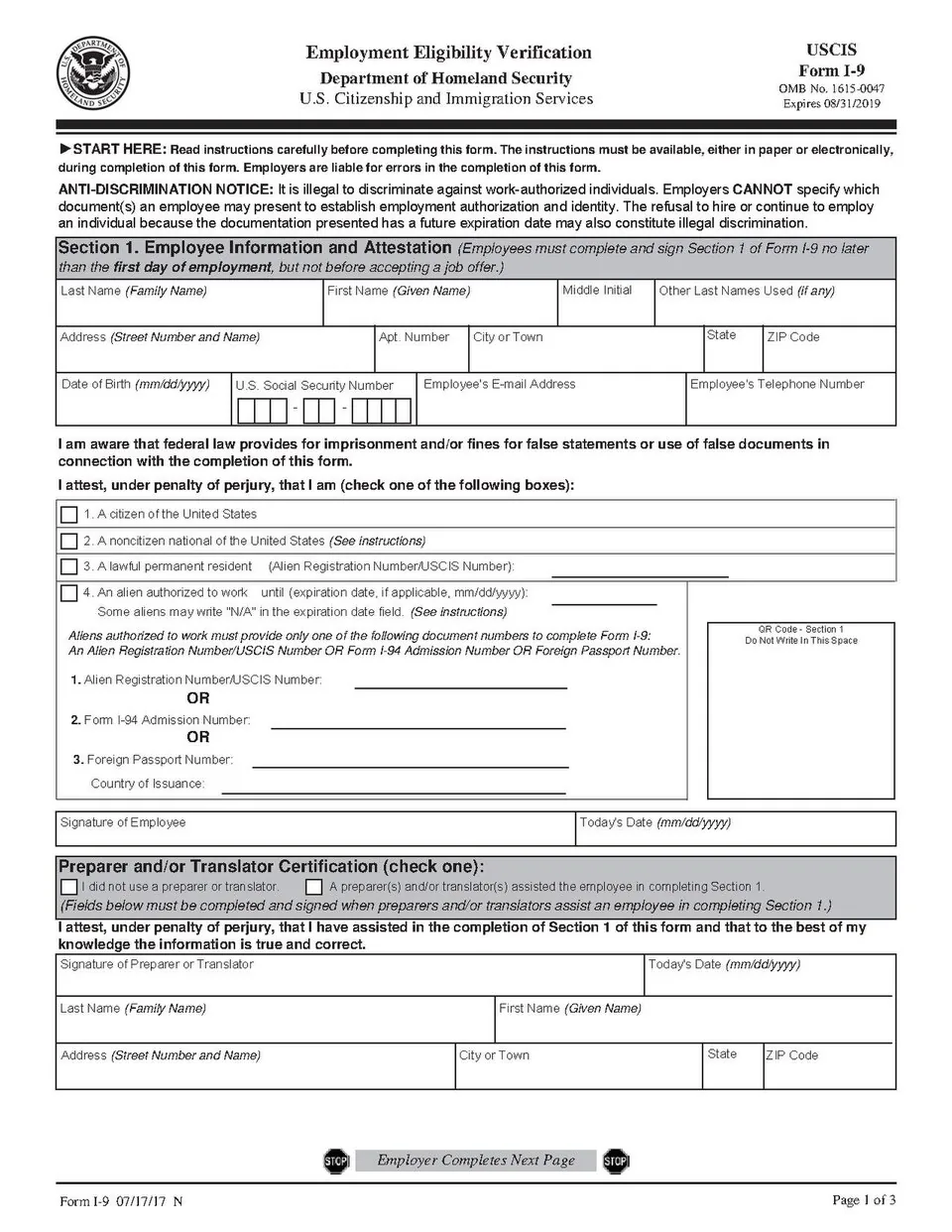
According to USCIS, every US employer must complete Form I-9 for each new hire and keep it for three years after hiring or one year after employment ends, whichever is later. The current edition is dated 01/20/25, and electronic I-9 systems had to be updated by July 31, 2026.
E-Verify, run by USCIS, is voluntary for most employers but required for federal contractors with the E-Verify clause and where state law requires it. Cases must be created by the third business day after a new hire starts work for pay.
HSI runs Form I-9 inspections. They begin with a Notice of Inspection, after which employers get at least three business days to produce forms and may be asked for payroll records. Since a March 16, 2026 ICE update, several errors once treated as technical, such as a missing date of birth, count as substantive, according to Morgan Lewis, which puts fines at $288 to $2,861 per form.
Frequently asked questions
Is ICE the same as Border Patrol?
No. Border Patrol is part of CBP, which focuses on borders and ports of entry. ICE handles interior enforcement, detention, removals and HSI investigations, and both sit inside DHS.
Who is the director of ICE in November 2026?
There is no Senate-confirmed director. David J. Venturella leads ICE as the senior official performing the duties of the director, after the White House withdrew Lance Schroyer's nomination on September 17, 2026.
How much funding does ICE have?
Beyond its regular budget, the July 4, 2025 law gave ICE $74.85 billion and the June 10, 2026 law added about $38.5 billion. Both remain available until September 30, 2029.
Can I find someone detained by ICE online?
Yes, at locator.ice.gov, using name, country of birth and either A-number or date of birth. People under 18 and, since September 15, 2026, most people with final removal orders do not appear, so contact the local ERO field office if you cannot find someone.
Do employers have to use E-Verify?
Not all of them. It is voluntary for most employers but required for federal contractors with the E-Verify clause and in some states. Every employer must complete Form I-9.
The bottom line
ICE, created in 2003, has three main parts, an acting leader and multi-year funding well above its regular budget. Its latest posted detention data run through mid-July 2026, courts are still deciding key detention questions, and anyone facing a case should rely on a licensed attorney or accredited representative.
For employers, the practical step is accuracy: careers pages, onboarding portals and HR pages that explain Form I-9 or E-Verify should link to current forms and say the same thing in every language you publish. I build multilingual careers and HR sections for US businesses, and I covered related work in my guide to state privacy laws for US websites. If your site needs a review, get in touch here.