How to Vote in the 2026 Midterms: A Step-by-Step Guide for November 3
By Eoin Villarin, 2026-11-02
Election Day is Tuesday, November 3, 2026. Here is how to check your registration, find your polling place, know what ID to bring and handle a mail ballot in time.
How do I vote in the 2026 midterm elections?
Election Day is Tuesday, November 3, 2026. Confirm your registration and polling place through vote.gov or your state election office, and bring any ID your state requires, since 36 states ask for some form of ID at the polls. If you still have a mail ballot, return it in person to an official drop box or election office before polls close where allowed, and stay in line if polls close while you wait.
Key takeaways
- Election Day is Tuesday, November 3, 2026, with all 435 House seats, 35 Senate seats and 36 governor races on the ballot.
- Ballotpedia counts 20 states and DC with Election Day voter registration, plus Connecticut for general elections, as of October 2026.
- AARP's 2026 guide says 36 states require some form of ID to vote in person, and 24 of them ask for a photo ID.
- On June 29, 2026, the Supreme Court ruled 5-4 in Watson v. RNC that federal law does not bar states from counting mail ballots postmarked by Election Day that arrive later.
- Under the Help America Vote Act of 2002, a voter whose name is missing from the list can ask for a provisional ballot.
- Jackson Lewis counts 28 states plus DC with some requirement that employers give workers time off to vote.
Election Day for the 2026 midterms is tomorrow, Tuesday, November 3. All 435 seats in the US House are on the ballot, along with 35 Senate seats and 36 governor races, plus state legislatures, local offices and ballot measures.
If you have not voted yet, the next 24 hours matter. Each state sets its own rules on registration, ID, hours and mail ballots, and the US Election Assistance Commission notes there are more than 10,000 election jurisdictions. This guide gives the general rule for each step and points you to the official place to confirm it.
The facts below come from vote.gov, the EAC's voter FAQs, official state election sites, Ballotpedia and other sources linked inline.
Election Day 2026 at a glance
| Question | Short answer |
|---|---|
| When is Election Day? | Tuesday, November 3, 2026 |
| What is on the ballot? | 435 House seats, 35 Senate seats, 36 governors, 30 attorneys general, 88 state legislative chambers and 145 statewide ballot measures |
| Can I still register? | On Election Day in 20 states and DC, plus Connecticut for this general election. Elsewhere, your state's earlier deadline applies |
| Do I need ID? | Depends on your state. 36 states require some form of ID at the polls, 24 of them a photo ID |
| Name not on the list? | Ask for a provisional ballot |
| In line when polls close? | Stay in line. You still have the right to vote |
| Still holding a mail ballot? | Hand-deliver it to an official drop box or election office before polls close, where allowed |
What is on the ballot in the 2026 midterms?
All 435 House districts are up for election, according to Ballotpedia. In the Senate, 33 seats are up in regular elections, plus special elections in Florida and Ohio to fill the final two years of existing terms, for 35 in total.
Ballotpedia also counts 36 governor races, 30 attorney general races, regular elections for 88 of the 99 state legislative chambers in 46 states, and 145 statewide ballot measures on November 3. City, county, school board and judicial races come on top.
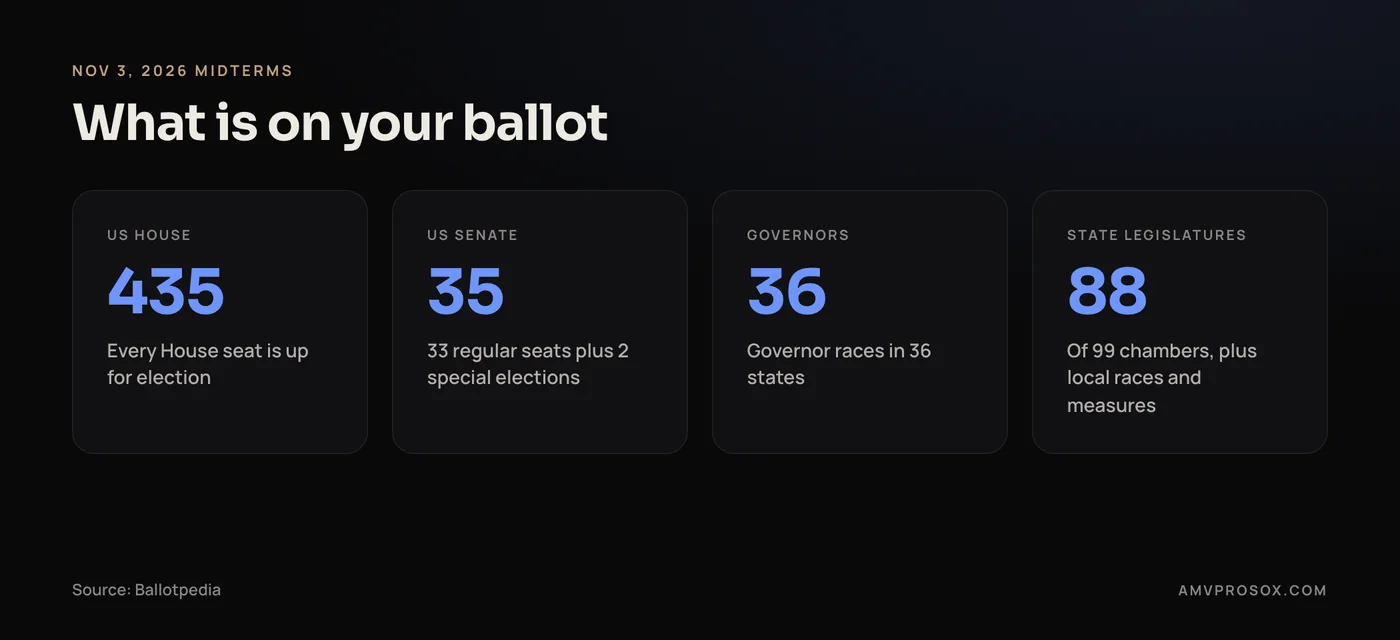
Your exact ballot depends on your address, and vote.gov notes that many election offices post sample ballots online. Read yours tonight.
How do I check if I am registered to vote?
On vote.gov, pick your state and you will reach its official registration lookup. Confirm that your legal name and current address are correct, especially if you moved or changed your name.
Vote.gov also notes that a registration can be marked inactive if you skipped at least two federal elections and did not respond when officials tried to reach you. Your local election office can help restore it. If you moved states recently, the federal rule letting you vote in your old state covers presidential elections only, so for this midterm, call your election office.
Can I still register to vote?
Possibly. There is no national deadline. Some states close registration 30 days before Election Day, while others let you register on Election Day itself, vote.gov says.
As of October 2026, Ballotpedia counts 20 states and DC with same-day registration on Election Day, plus Connecticut, which offers it for general elections like this one. Other trackers' counts differ slightly, so confirm with your state. You generally need proof of identity and residency, such as a driver's license plus a utility bill or pay stub.
In Michigan, unregistered voters can register at their local clerk's office until 8 p.m. on Election Day and vote there. California's Same Day Voter Registration works at county election offices, polling places and vote centers, and those ballots count once the registration is verified.
Where do I vote, and when are the polls open?
Find your polling place on your state's election website, which the EAC's state directory links to. Check it even if you voted there before, because locations can change. Some counties use vote centers open to any county voter, while others require your assigned precinct. Texas uses both, depending on the county.
Hours vary by jurisdiction. Three examples from official state sites:
| State | Election Day hours | ID at the polls | Missed the registration deadline? |
|---|---|---|---|
| Texas | 7 a.m. to 7 p.m. statewide | Photo ID required, with a Reasonable Impediment Declaration option if you cannot reasonably get one | No Election Day registration. The deadline was October 5 |
| California | 7 a.m. to 8 p.m. | Most voters do not need ID. Some first-time voters may be asked | Same Day Voter Registration is available |
| Michigan | 7 a.m. to 8 p.m. local time | Photo ID requested but not required. Sign an affidavit if you do not have one | Register at your local clerk's office until 8 p.m. |
Sources: VoteTexas.gov, the California Secretary of State and the Michigan Secretary of State.
What do I need to bring to vote?
Mainly ID, if your state asks for it. AARP's 2026 voter guide counts 36 states that require some form of ID to vote in person, 24 of them a photo ID. The other 14 states and DC verify voters in other ways, such as checking signatures.
Some ID states have a fallback. Texas accepts seven forms of photo ID, but voters who cannot reasonably obtain one can sign a Reasonable Impediment Declaration and show a supporting document such as a utility bill. If you own an approved ID but left it at home, Texas lets you vote provisionally and show it to the county registrar within six days. Michigan lets voters without photo ID sign an affidavit, and those ballots count like any other. In California, most voters show no ID at all.
- You do not need your voter registration card, according to vote.gov.
- Michigan allows you to bring a voter guide or notes, as long as you take them with you. Check your state's rule.
- Leave campaign gear at home. Michigan bans campaign clothing, stickers and flyers within 100 feet of a polling place.
- Do not take photos in the voting area unless your state allows it.
I still have my mail ballot. What is the deadline?
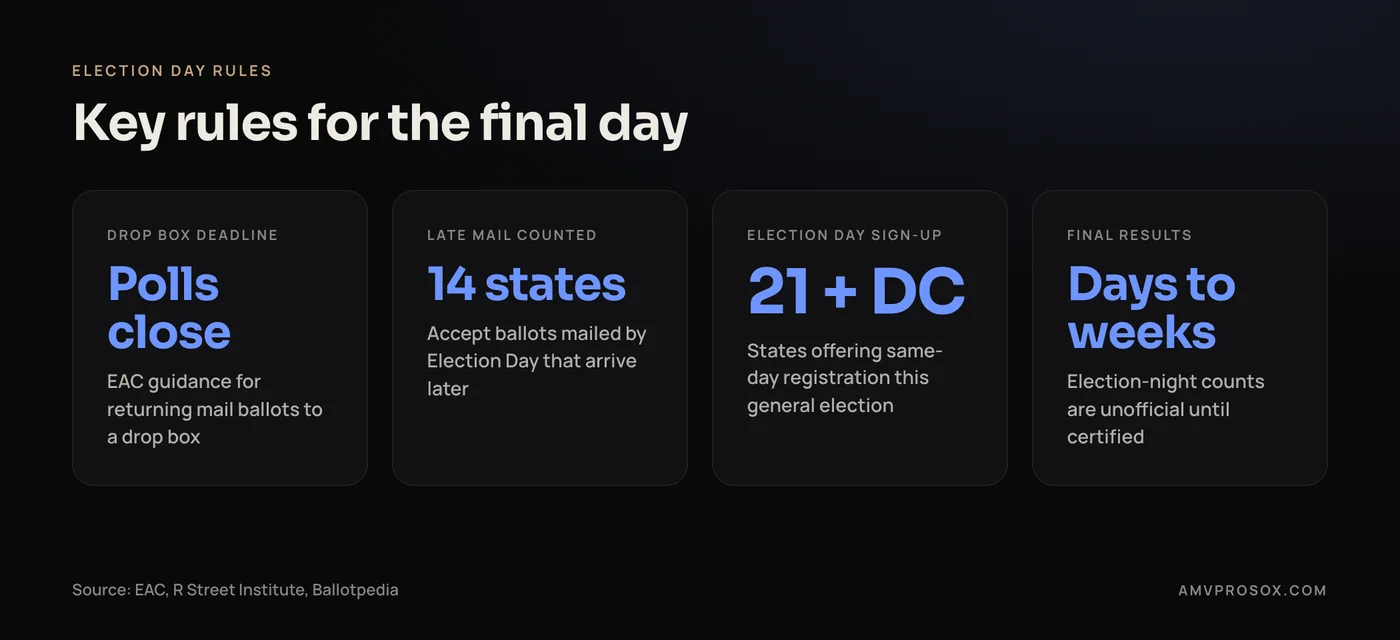
With one day left, the safest move is usually to skip the mail, since the EAC recommends mailing at least a week before your state's deadline. Return your ballot in person to an official drop box or your election office instead, where your state allows it. Neither needs a stamp, and the EAC says drop box ballots should go in no later than the close of polls.
Complete everything on the return envelope first. Some states require a witness or notary signature, and missing information can keep a ballot from counting. Many states let you track your ballot online.
On June 29, 2026, the Supreme Court ruled 5-4 in Watson v. Republican National Committee that federal election-day laws do not stop Mississippi from counting ballots postmarked by Election Day that arrive up to five days later, SCOTUSblog reported. That leaves the receipt deadline to each state. The R Street Institute counts 14 states that accept late-arriving ballots mailed by Election Day, with grace periods from one day in Texas to 21 days in Washington.
California, for example, requires mail ballots to be postmarked by Election Day and received within seven days, or dropped off by 8 p.m. on November 3. If your state uses a postmark rule and you must mail tomorrow, ask the post office counter clerk to hand-cancel it. A USPS memo dated October 1, 2026 says retail employees must do so when a customer asks. Where ballots must arrive by Election Day, mailing now is a real risk.
Prefer to vote in person? California lets you exchange your mail ballot at your polling place, while elsewhere you may get a provisional ballot. Ask your election office.
What if my name is not on the voter list?
Do not leave without voting. Under the Help America Vote Act of 2002, you can ask for a provisional ballot, as the EAC explains. First ask the poll worker to recheck the spelling of your name and confirm you are at the right location for your address.
Provisional ballots are kept separate and counted only after officials verify your eligibility. Before leaving, ask how to check whether yours counted and whether you need to bring anything, such as ID, to the election office afterward.
Can I get help at the polls?
Yes. Vote.gov lists accommodations protected by law, including at least one accessible voting device at every location, poll workers to help you use it, accessible parking, large-print materials and service animals. If your location is not accessible, ask about curbside voting or another site.
If you need help because of a disability, blindness or difficulty reading or writing, Section 208 of the Voting Rights Act lets you bring a person of your choice, except your employer or an officer or agent of your union, according to the Department of Justice. You can also ask a poll worker for language help.
What if the polls close while I am in line?
Stay in line. The EAC lists voting while still in line at closing time among the rights federal election laws generally protect, and California includes it in its voter bill of rights.
What should I do if something goes wrong?
- A mistake on your ballot: before casting it, ask a poll worker for a new one. The EAC lists this as a voter right.
- A machine or process problem: tell the poll worker in charge, then call your local election office.
- Your right to vote is questioned, or an accommodation is denied: report it to the Justice Department's Civil Rights Division at civilrights.justice.gov or 800-253-3931.
- Violence, threats or intimidation: call 911 first, then report it to the Justice Department, as the EAC advises.
When will we know the election results?
Expect unofficial results on election night and a fuller picture over the following days. The EAC explains that election-night numbers are never final, because officials keep counting eligible mail, provisional, and military and overseas ballots. Certified results can take several days or sometimes weeks, and close races can go to a recount. Follow official results on your state's election website.
If you run a business: giving staff time to vote
No federal law requires private employers to give workers time off to vote, but 28 states and DC have some form of voting leave requirement, according to a September 2026 overview from employment law firm Jackson Lewis. Whether that time is paid varies, and some states require a posted notice, such as California at least 10 days before a statewide election.
Beyond the legal minimum, a little flexibility helps: let people start late or leave early. If you change opening hours tomorrow, update your website and Google Business Profile so customers do not make a wasted trip. I explain why accurate hours matter in AI search answers in my guide to staying visible in Google AI Mode. For your obligations, check with your state labor department.
Frequently asked questions
Can I vote if I forgot my ID?
Often yes, but it depends on your state. Michigan lets you sign an affidavit and vote a regular ballot, while Texas lets you vote provisionally and show your ID within six days. Check your state's rules through vote.gov.
Is it too late to mail my absentee ballot?
It may be. The EAC recommends mailing at least a week before your state's deadline, and some states require ballots to arrive by Election Day. Returning it in person to an official drop box or election office before polls close is safer where allowed.
Does my employer have to give me time off to vote?
It depends on your state. Jackson Lewis counts 28 states and DC with some voting leave rule, and no federal law requires it for private employers. Check your state labor department for whether the time is paid.
How do I know if my provisional ballot was counted?
Ask the poll worker how your state lets you check. Michigan, for example, lets voters track ballot status at Michigan.gov/Vote. Provisional ballots count only after officials confirm your eligibility.
The bottom line
Tonight, take ten minutes: confirm your registration, look up your polling place and hours, check your state's ID rule and read your sample ballot. If you still hold a mail ballot, hand-deliver it before polls close where allowed. Tomorrow, if something goes wrong, ask for a provisional ballot rather than leaving, and stay in line if polls close while you wait. For anything state-specific, trust vote.gov, the EAC and your local election office.
I build websites for small businesses, mostly in the US, and days like this are a reminder that clear, current information, from opening hours to staff notices, saves everyone time. If you would like help keeping your site accurate and easy to update, send me a message, or browse my case studies.