The Latest Claude Model in November 2026: Opus 5.5, Prices and What's New
By Eoin Villarin, 2026-11-02
Claude Opus 5.5 is Anthropic's recommended model, Haiku 5.5 dropped prices to $0.10 per million tokens, and Duet arrived. Verified prices, rivals and business uses.
What is the latest Claude model and how much does it cost?
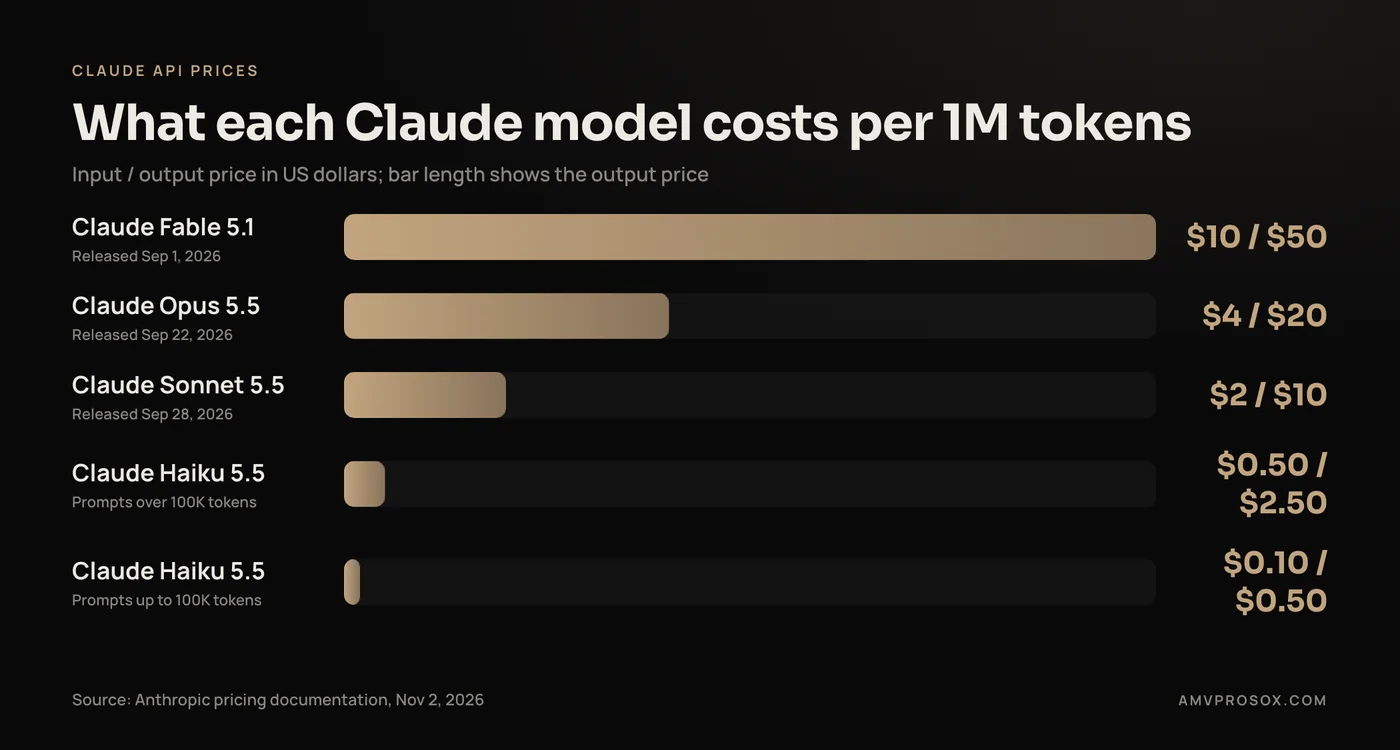
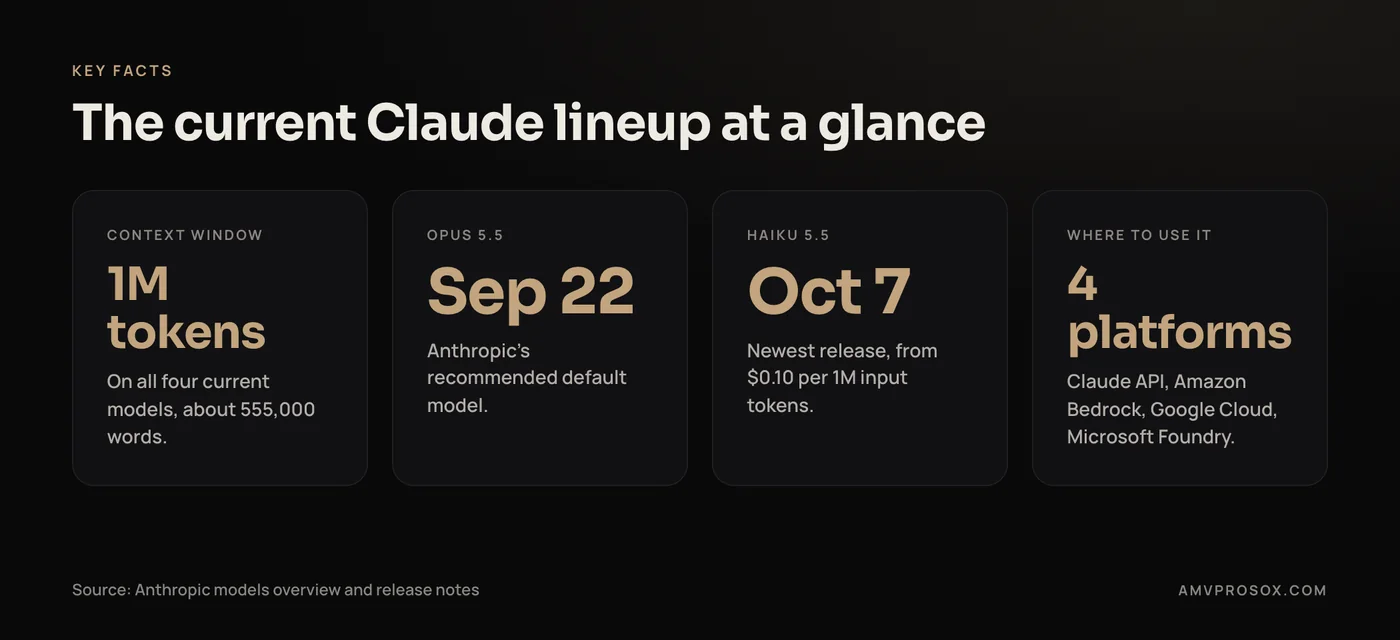
As of November 2, 2026, Anthropic recommends Claude Opus 5.5 (released September 22, 2026) for most work, at $4 per million input tokens and $20 per million output tokens. The newest release is Claude Haiku 5.5 (October 7, 2026), from $0.10 and $0.50, alongside Sonnet 5.5 at $2 and $10 and Fable 5.1 at $10 and $50. All four have a 1 million token context window and run on the Claude API, Amazon Bedrock, Google Cloud and Microsoft Foundry.
Key takeaways
- Anthropic released Claude Opus 5.5 on September 22, 2026, at $4 input and $20 output per million tokens, down from $5 and $25 for Opus 5.
- Claude Haiku 5.5, released October 7, 2026, costs $0.10 input and $0.50 output per million tokens for prompts up to 100,000 tokens, versus $1 and $5 for Haiku 4.5.
- All four current Claude models, Fable 5.1, Opus 5.5, Sonnet 5.5 and Haiku 5.5, have a 1 million token context window and 128,000 token max output.
- On the independent Artificial Analysis Intelligence Index on November 2, 2026, Claude Opus 5.5 scored 58, behind Gemini 4 Carbon at 59 and ahead of GPT-6 Astra at 57.
- Anthropic launched Claude Duet, a proactive agent app, as a US waitlist research preview on October 21, 2026, for Pro, Max and Ultra users.
- Anthropic filed a Form S-1 on October 26, 2026, for a proposed Nasdaq listing under the symbol ANT, with no share count or price range set.
If you opened Claude recently and wondered which model you are actually using, you are not alone. Anthropic released four new models in just over five weeks this fall: Claude Fable 5.1 on September 1, Claude Opus 5.5 on September 22, Claude Sonnet 5.5 on September 28 and Claude Haiku 5.5 on October 7, 2026.
As of November 2, 2026, Anthropic's own documentation tells developers to "start with Claude Opus 5.5 for most workloads". Opus 5.5 costs $4 per million input tokens and $20 per million output tokens, 20% less per token than Opus 5, and every current Claude model can read up to 1 million tokens at once. October also brought a proactive assistant called Claude Duet and Anthropic's IPO filing, so if you pay for an AI chatbot or automation, here is what changed.
Facts below come from Anthropic's newsroom, docs and pricing pages, OpenAI's and Google's official pricing pages, TechCrunch, CNBC, Reuters and independent tests by Artificial Analysis. Scores a company published about its own model are labeled self-reported.
The latest Claude models at a glance
| Model | Released | API price per 1M tokens (input / output) | Best for |
|---|---|---|---|
| Claude Fable 5.1 | Sep 1, 2026 | $10 / $50 | The hardest reasoning and long agent tasks |
| Claude Opus 5.5 | Sep 22, 2026 | $4 / $20 | Anthropic's recommended default |
| Claude Sonnet 5.5 | Sep 28, 2026 | $2 / $10 | Fast, cheaper everyday work |
| Claude Haiku 5.5 | Oct 7, 2026 | From $0.10 / $0.50 | High-volume tasks like sorting and extraction |
- Context window: 1 million tokens on all four, which Anthropic says is roughly 555,000 words.
- Max output: 128,000 tokens per response.
- Knowledge cutoff: June 2026 for all four.
- Where to get them: the Claude apps, the Claude API, Amazon Bedrock, Google Cloud's Vertex AI and Microsoft Foundry.
What is the latest Claude model right now?
Claude Opus 5.5 is the model Anthropic points most people to, and Claude Haiku 5.5 is the newest release. Anthropic says in its launch post that Opus 5.5 performs at the level of Claude Fable 5.1 on most work while costing about 40% less to run than Opus 5.
Fable 5.1 costs 2.5 times as much and, per its model page, is meant for demanding reasoning and long-horizon agent work. Its twin, Claude Mythos 5.1, is offered only to organizations verified through Anthropic's cyber and life sciences programs.
In the Claude apps, your plan decides: Free includes Sonnet and Haiku, Pro adds Opus, and Max includes Fable up to half of its weekly limit.
What is new in Claude Opus 5.5, Sonnet 5.5 and Haiku 5.5?
Opus 5.5: lower prices and Fable-level claims
Opus 5.5 costs $4 input and $20 output, down from $5 and $25 for Opus 5. TechCrunch noted the model also uses less jargon and puts key information at the start of its messages.
In Anthropic's self-reported results, Opus 5.5 scored 66.4% on Terminal-Bench 4.0, an agentic coding test, versus 57.9% for OpenAI's GPT-6 Astra, and 81.8% on the OSWorld 2.1 computer-use test. Anthropic itself cautions that benchmark margins are a less reliable guide to real-world differences. An optional fast mode runs up to 2.5 times faster at $8 input and $40 output.
Sonnet 5.5: the cheaper workhorse
Sonnet 5.5 costs half as much as Opus 5.5. Anthropic says it writes output more than 30% faster than Sonnet 5 and needs fewer tokens per task. In its self-reported numbers, Sonnet 5.5 actually beat Opus 5.5 on Terminal-Bench 4.0 with 70.6%. Zendesk, quoted in the announcement, said tickets were processed 20% faster.
Anthropic's Theo Chu told CNBC that Sonnet is aimed at cost-conscious customers who may not need as much intelligence.
Haiku 5.5: the big price drop
Haiku 5.5 is the change small businesses should notice most. For prompts up to 100,000 tokens it costs $0.10 input and $0.50 output, compared with $1 and $5 for Haiku 4.5. Longer prompts cost $0.50 and $2.50, but Anthropic's Haiku 5.5 announcement says about 90% of Haiku 4.5 requests fell into the cheaper tier.
What else did Anthropic announce in October 2026?
- Claude Duet (October 21): a standalone app where Claude works as a proactive agent. It sends a morning brief, watches apps such as Gmail, Slack, QuickBooks and Shopify, and runs tasks in the background. It is a waitlist research preview for US users on Pro, Max and Ultra plans.
- Monthly API credits (October 7): $100 for Max, $200 for Ultra and up to $500 pooled for Team plans.
- Agent Skills (October 22): Anthropic donated the standard to the Linux Foundation's Agentic AI Foundation.
- Usage Policy update (October 8): the revised rules take effect November 12 and add a section on deceptive activity such as fake accounts.
- IPO filing (October 26): Anthropic filed a Form S-1 for a proposed Nasdaq listing under "ANT", with no share count or price range set. TNW's summary of the filing reports first-half 2026 revenue of $16.3 billion. This is news, not investment advice.
For the wider picture across OpenAI, Google and others last month, see my AI news roundup for October 2026.
How much does Claude cost in November 2026?
Per Anthropic's pricing documentation, the Batch API takes 50% off for work that can wait, cached prompt reads on Opus 5.5 and Sonnet 5.5 cost 5% of the input price, and web search adds $10 per 1,000 searches. App subscriptions are simpler:
| Plan | US price | Highlights |
|---|---|---|
| Free | $0 | Sonnet and Haiku, web search, memory, limited usage |
| Pro | $20/month, or $17/month billed annually | Adds Opus, Claude Code and Research |
| Max | $100/month | 5x Pro usage, Fable up to half the weekly limit, $100 monthly API credit |
| Ultra | $200/month | 10x Pro weekly usage, $200 monthly API credit |
| Team | $25 per seat monthly, $20 annually (Standard) | 2 to 150 users, admin tools, Claude Code and Cowork |
| Enterprise | $20 per seat monthly, billed annually, plus usage | 20-seat minimum, SCIM, audit logs, Compliance API |
How does Claude compare with GPT-6 and Gemini 4?
On price, Anthropic sits in the middle. List prices for standard-length prompts, from OpenAI's pricing page and Google's Gemini API pricing page:
| Model | Input / output per 1M tokens | Notes |
|---|---|---|
| Claude Opus 5.5 | $4 / $20 | Same price up to the full 1M context |
| Claude Sonnet 5.5 | $2 / $10 | Same price up to the full 1M context |
| OpenAI GPT-6 Astra | $10 / $50 | $20 / $75 for prompts over 272K tokens |
| OpenAI GPT-6.1 Sol | $2 / $10 | $4 / $15 for prompts over 272K tokens |
| Google Gemini 4 Argon | $2 / $10 | Introductory until Nov 30; $4 / $20 from Dec 1 |
OpenAI says GPT-6.1 Sol, launched September 29, nearly matches GPT-6 Astra at one-fifth of its token prices, TechCrunch reported. Google brought Gemini 4 Argon to AI Pro and Ultra subscribers on October 13, and on October 28 announced Gemini 4 Carbon, which is limited to a small group of cyber defenders for now, as Reuters reported.
Independent test results
On the Artificial Analysis Intelligence Index, an independent benchmark, scores on November 2 were close at the top:
- Gemini 4 Carbon (high): 59
- Claude Opus 5.5 (max): 58
- GPT-6 Astra (max): 57
- GPT-6.1 Sol (max): 55
- Claude Sonnet 5.5 (max): 54
- Gemini 4 Argon (high) and Claude Fable 5.1 (xhigh): 50 each
- Claude Haiku 5.5 (max): 36
Sticker price is not the whole story. Artificial Analysis puts the cost per task on its index at $10.04 for Opus 5.5 at max effort, against $6.24 for GPT-6 Astra and $1.27 for GPT-6.1 Sol at the same setting. Its Opus 5.5 page also flags the model as very verbose, with 220 million output tokens on the index versus a median of 71 million. Lower effort settings cost far less, so test on your own tasks.
How can a small business use the latest Claude?
Customer support. A website chatbot is the obvious starting point, and Haiku 5.5 makes it cheap: a bot answering 10,000 questions a month, at about 2,000 input tokens and 300 output tokens each, would come to roughly $3.50 in Haiku 5.5 tokens, $70 on Sonnet 5.5 or $140 on Opus 5.5. That is my arithmetic from list prices; real bills depend on output length and caching. Serving Europe? Read my guide to the EU AI Act chatbot transparency rules.
Content. Opus 5.5 and Sonnet 5.5 draft product descriptions, emails, proposals and documents well. Check facts and prices before publishing.
Automation. Haiku 5.5 is built for sorting, extracting and routing: tagging emails, pulling order details from messages or summarizing threads. Duet shows where this is heading.
Coding. Claude Code is included from the Pro plan up. For what these tools can and cannot replace, see vibe coding versus hiring a web developer.
For developers: model IDs, context and migration notes
- Model IDs: claude-opus-5-5, claude-sonnet-5-5, claude-haiku-5-5 and claude-fable-5-1. On Amazon Bedrock, add the "anthropic." prefix.
- Breaking changes: thinking cannot be disabled on Opus 5.5, and forced tool use (a tool_choice of "any" or "tool") returns a 400 error on Opus 5.5 and Sonnet 5.5. Code written for Haiku 4.5 can break on Haiku 5.5 if it uses budget_tokens, sampling parameters or prefill.
- New SDKs: API version 2026-10-21 arrived October 21 with new major SDKs, including Python 2.0.0 and TypeScript 1.0.0, with breaking changes.
- Deadlines: Claude Sonnet 4.5 retires on November 30, 2026, and fast mode for Opus 4.8 is removed the same day, per the platform release notes.
What are the limits and safety notes?
- Safeguards can block legitimate work. On Opus 5.5, many cybersecurity tasks are rerouted to the older Opus 4.8. On Sonnet 5.5, higher-risk cyber requests fall back to Sonnet 5, and Anthropic warns some microbiology and virology requests may be flagged in error.
- Outputs carry a watermark. Anthropic's Fable 5.1 announcement says output from models released after August 2, 2026 carries an invisible watermark for EU AI Act compliance, with no user information in it.
- Agents still make mistakes. Anthropic says Duet may misread a thread or misjudge what is urgent. It asks for approval before sending messages, making payments, signing documents or deleting anything.
- Keep a human in the loop for anything customer-facing, legal, medical or financial. Benchmarks measure general tasks, not your products or policies.
Frequently asked questions
What is the newest Claude model?
Claude Haiku 5.5, released October 7, 2026, is the newest release. Claude Opus 5.5, released September 22, is the model Anthropic recommends for most work. Fable 5.1 is the top-priced tier.
Is Claude Opus 5.5 free to use?
No. The Free plan includes Sonnet and Haiku with limited usage. Opus starts with the Pro plan at $20 a month, or $17 a month billed annually.
How much does the Claude API cost?
Per million tokens, Opus 5.5 is $4 input and $20 output, Sonnet 5.5 is $2 and $10, Haiku 5.5 starts at $0.10 and $0.50, and Fable 5.1 is $10 and $50. The Batch API cuts these by 50%.
Is Claude better than ChatGPT or Gemini?
It depends on the task. On the independent Artificial Analysis Intelligence Index, Claude Opus 5.5 scored 58, between Google's limited-access Gemini 4 Carbon at 59 and OpenAI's GPT-6 Astra at 57. Cost per finished task varies a lot.
Can I use Claude on AWS or Google Cloud?
Yes. All four current models are listed on Amazon Bedrock, Google Cloud's Vertex AI and Microsoft Foundry as well as Anthropic's own API. Cloud providers bill you directly.
Is Anthropic a public company now?
Not yet. Anthropic filed a Form S-1 on October 26, 2026, for a proposed Nasdaq listing under "ANT", but the registration had not become effective and no share count or price range had been set.
The bottom line
The latest Claude lineup is Opus 5.5 for most work, Sonnet 5.5 for cheaper everyday tasks, Haiku 5.5 for high-volume jobs at a fraction of Haiku 4.5's price, and Fable 5.1 for the hardest problems. Independent tests put Opus 5.5 within a point of the top, but the best model is still the cheapest one that reliably handles your tasks.
If you want a Claude-powered support chatbot, an automation that saves your team hours, or a website built to work with these tools, that is exactly the kind of work I do. You can browse my case studies or tell me about your project, and I will suggest the model and setup that fit your budget.